Cleaning Contract KPIs: How Do You Know If Your Cleaning Contract Is Really Performing?
A cleaning audit says 95%. Everything is green. So the contract must be performing well — right?
Not necessarily. We've all seen reports where the headline numbers look healthy but the experience on the ground tells a different story. The same washroom issue keeps coming back. A supervisor is spending every evening covering absence. Training is slipping. Actions from the last review are still outstanding. Or one school in a multi-site contract is struggling while the overall Trust score stays comfortably green.
None of that makes the 95% wrong. It simply means one number isn't telling you the whole story. After more than 30 years in commercial cleaning, we've learned that understanding whether a contract is genuinely performing means looking beyond the audit percentage — and that's led us to think differently about how we use data at ICS Cleaning. We're developing OneView to bring the important parts of contract delivery together and give customers and operational teams better visibility of what's really happening. Not more data for its own sake — better information, greater transparency and clearer accountability for what happens next.
What KPIs should you use to measure a cleaning contract?
A cleaning contract should normally measure quality, service delivery, staffing and training, corrective actions and management performance. For multi-site contracts, those measures should be visible at both individual-site and organisation level.
The difficult part isn't deciding which numbers to put on a dashboard — it's understanding what those numbers are telling you. An audit score tells you something; attendance tells you something else; training compliance, complaints, management visits and outstanding actions each add a piece. Look at them individually and you have a list of KPIs. Look at them together and you start to understand the health of the contract.
In brief: five KPI areas worth measuring
A useful cleaning KPI framework should normally cover: cleaning quality (audit results, defects), service delivery (task completion, response), staffing and training (attendance, cover, training status), corrective actions (open/overdue, evidence resolved), and contract management (visits, escalation, reporting).
There's no single universal "good" percentage — targets need to reflect the actual specification and contract, not a generic benchmark.
A good audit score doesn't always mean a good cleaning contract
Cleaning audits matter — a structured inspection gives the customer and our management team evidence that agreed standards are being achieved. But an audit is largely a snapshot.
Imagine this (illustrative example only): a cleaning audit scores 95%. Now add context: attendance is declining, several training records are overdue, four corrective actions are still open, washrooms are a recurring issue, and a management visit is overdue. Would you still call that "95% performing"? Probably not — the standard may still be met today, but there are warning signs underneath it. A School Business Manager or Facilities Manager doesn't just want to know "are we clean today?" — they want to know if a problem is developing for next week or next month.
We look at cleaning performance from three angles
We think about performance in three areas: what standard are we achieving, what's happening operationally behind that standard, and how effectively is the contract managed. You need all three.
Quality and output — audit scores, failed areas, specification compliance, complaints, recurring defects, periodic completion and customer feedback. They tell you the result, but not always why a classroom keeps failing inspection: a missed task, an unrealistic specification, uncovered absence, a training gap, changed building use, weak supervision — or the same issue raised three times with nobody fixing the cause.
Operational performance — attendance, absence, staffing cover, retention, training, supervision, task completion, site visits and outstanding issues. This can say more about where a contract is heading than today's audit score. Two schools both at 96% (illustrative only) can be in very different positions: one with stable staffing and closing actions, the other with rising absence and overdue actions.
Management performance — is the contractor actually managing the contract, not just cleaning it: supervision visits, communication, action closure, escalation, review meetings, reporting accuracy. If the same problem appears on three consecutive audits, that's a management question — why hasn't somebody prevented it happening again? A good contractor shouldn't be frightened of measuring its own management performance; customers should be able to see it.
What are leading and lagging cleaning KPIs?
Lagging KPIs tell you what's already happened — an audit failure, a complaint. Leading KPIs can flag a problem developing — rising absence, falling training compliance, missed management visits, growing overdue actions. None of these guarantee standards will fall, but they're worth watching. We'd rather spot a developing problem before the Business Manager has to email us about it — that's the difference between data for a report and data for managing a contract.
What does official UK guidance say about KPIs?
Cabinet Office guidance on Key Performance Indicators defines a KPI as a measure assessing supplier performance against agreed targets. It's written for public procurement, not cleaning specifically, but the principle holds: a KPI should connect to something genuinely deliverable, with someone owning the result and acting on it.
Closing an action isn't the same as solving a problem
An audit flags an issue, an action is raised, someone marks it complete — job done? Maybe. The better questions: what happened, why, who owned it, what changed, did it work, has it recurred? That last one matters most — repeatedly closing the same failure can look like activity without actually fixing anything. The goal isn't a dashboard of green ticks; it's fixing the underlying problem.
A useful performance-management example from healthcare
Healthcare cleaning operates in a very different environment from the commercial and education cleaning services ICS typically delivers, so NHS England's National Standards of Healthcare Cleanliness 2025 should not be applied directly to those contracts. But NHS England's approach is a useful example of mature performance management: defined standards, audit evidence and transparent reporting working together, not one headline score.
The wider principle applies to any managed cleaning contract: an audit result matters more when linked to recurring issues, corrective action, ownership and evidence the problem was actually resolved.
Managing one school is different from managing 13
Imagine you're responsible for cleaning across 13 schools (illustrative example only). The Business Manager wants to know what's happening in their school. The Trust Estates lead needs the picture across all 13. Trust leadership may just need reassurance the contract is performing and exceptions are managed. Sending 13 separate reports isn't the answer — but neither is one Trust-wide percentage.
Why can a Trust-wide cleaning KPI hide problems?
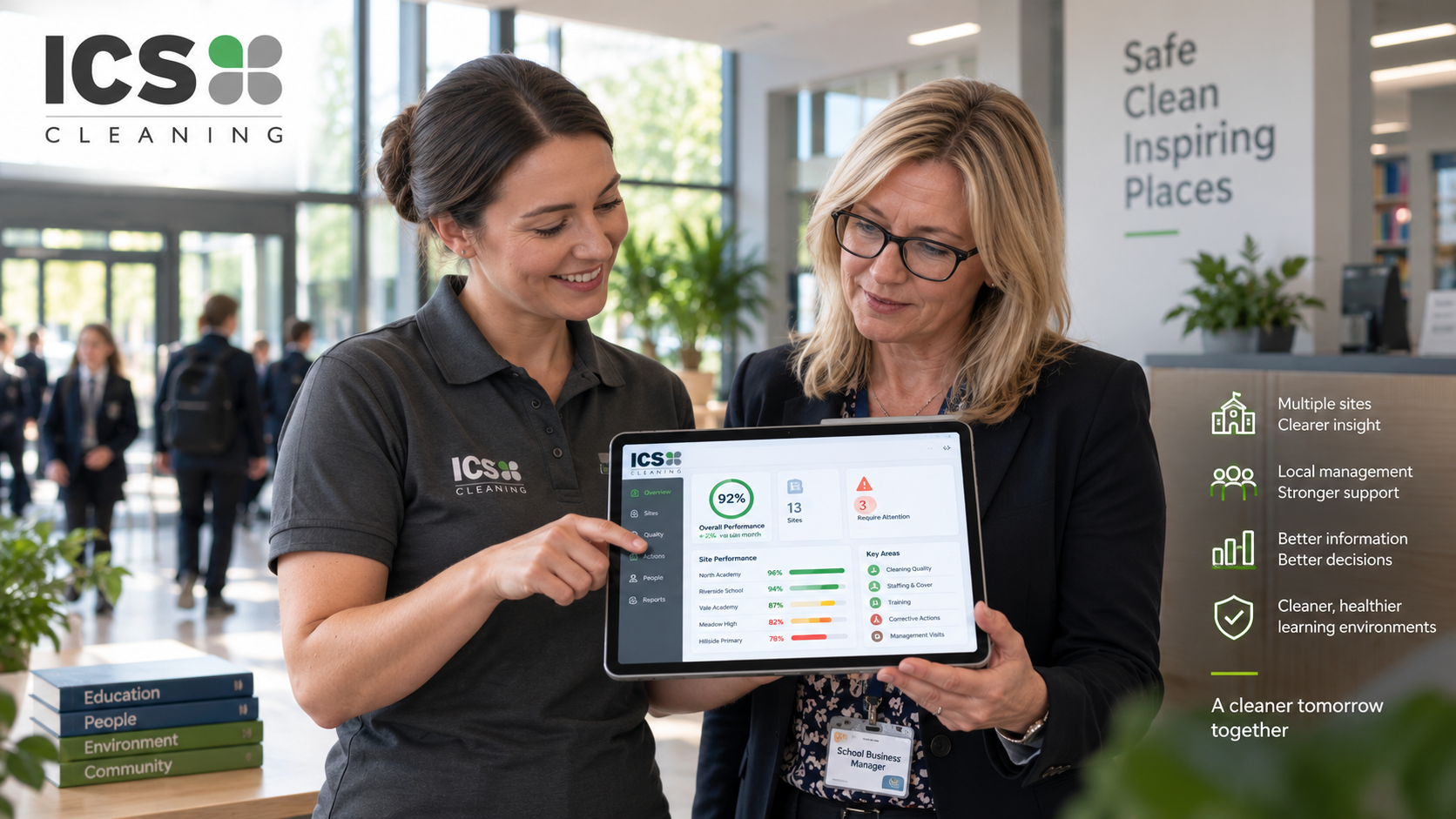
A Trust-wide average can hide a struggling site, because a small number of low scores get absorbed without ever becoming visible on their own. Imagine overall performance across 13 schools is 92% (illustrative only) — healthy-sounding. But if 12 schools are fine and one is struggling badly, the average can still be green. If you're the Business Manager at the struggling school, "the Trust is at 92%" isn't much help — you need to know what's wrong, who knows, what's being done, and when it'll be fixed.
Good multi-site reporting answers both sides: the centre needs the 13-school view, the individual manager still needs the one-school view. A useful Trust-level view might look like this (illustrative example only):
| Measure | Trust position | What needs attention? |
|---|---|---|
| Cleaning quality | 94% | 2 schools |
| Service delivery | 92% | 2 schools |
| Training | 88% | 3 schools |
| Corrective actions | 79% | 9 actions overdue |
| Management reviews | 96% | 1 review outstanding |
The table matters less than what happens next — moving from Trust to KPI to School to Issue to Action to Resolution. Which schools are driving low training? Where has quality fallen? Are three schools sharing the same failure? That's when data becomes useful management information, an idea explored further in Managing Multi-Site Cleaning Contracts: Delivering Greater Value Through Data, Technology and Partnership.
Different people need different views of the same contract
A School Business Manager wants to know if their school is getting the agreed service and whether raised issues are handled. A Trust Estates or Facilities Manager wants to know which schools need attention and whether patterns are developing. Senior leadership wants to know if the contract is performing overall and risks are controlled. Our ICS Area Manager needs to know where to intervene today. The underlying information is the same; the useful view of it isn't.
We've all seen reports where everything is green but the customer isn't happy
Reality doesn't always fit neatly into a dashboard. A contract can look green while a Business Manager is quietly frustrated. An audit can score 95% while the same issue keeps returning. A staffing KPI can look fine while a supervisor is spending every evening finding cover. That's why we don't believe technology should replace conversations, site visits or experienced management — it should help us see where those visits are most needed.
Why ICS Cleaning has chosen to stay regional
We're ambitious about ICS, but that doesn't mean becoming a national cleaning company. We've deliberately focused our cleaning operations across Yorkshire and Lincolnshire for a practical reason: a dashboard can tell us a customer needs attention, but it can't drive to the site. We'd rather our managers spend their time visiting customers, supporting site teams, meeting Business Managers, investigating problems and supporting supervisors, than travelling hundreds of miles between contracts nationally. Being regional isn't something we're growing out of — it's part of the operating model, and it's how local management and technology work together: technology tells us where to look, and someone close enough can actually go and look.
Why we're developing OneView
Cleaning contract information already exists — audits, training, staffing, actions, requests, visits, periodic schedules, review meetings — but it often sits in different places and only comes together when someone writes a report. That's why we've developed ICS OneView: our evolving approach to bringing relevant contract information together for a clearer picture of what's happening, covering audits, KPIs, corrective actions, staffing, training, visits, periodic cleaning and performance trends where relevant to the contract. We're progressively introducing it within our existing customer base where appropriate, and continuing to develop it as we learn — we're not pretending it's been running unchanged for years.
Some customers need straightforward reporting; schools, academy trusts and other multi-site organisations can benefit from more detailed oversight. We don't force every customer into the same dashboard — the information should reflect the contract. What matters is the principle: make the important things visible, whether good or bad, and if the same problem keeps coming back, ask why. It's about better visibility, not more data — a dashboard with 50 KPIs can be as unhelpful as a 30-page report if it doesn't help someone make a decision.
From monthly reporting to active contract management
Traditional reporting is often retrospective: service delivered, month ends, data collected, report produced, meeting held, problem discussed. There's still a place for that — but we want the underlying process to be more active: measure, identify, act, verify, improve. If an audit flags a significant issue, why wait for next month's meeting? If an action is overdue, why wait for someone to spot it in a spreadsheet?
Where does AI fit into cleaning contract management?
Carefully. We're exploring AI-assisted capabilities through IntelliClean™ as part of OneView's development, but our principle is straightforward: AI-assisted, not AI-controlled. We don't think AI should make disciplinary, contractual or commercial decisions, and a computer-generated recommendation should never replace an experienced manager who knows the site. Where AI is useful is spotting patterns in growing amounts of information — a recurring issue, overdue actions, a school drifting from the rest of the Trust. The technology surfaces something worth investigating; a person decides what to do about it.
What should Business Managers and Facilities Managers ask their cleaning contractor?
Don't rely solely on the latest audit percentage. Worth asking: are we actually receiving the agreed service? Which areas repeatedly fall below standard? What actions are outstanding, who owns them, and when are they due? How quickly are problems resolved, and do the same ones keep recurring? Are staffing and cover stable, and is training current? Are management visits actually happening? Can you compare different schools without reading a separate report for each, and see trends over months rather than a single snapshot? And can your contractor prove a corrective action actually worked — ticking it complete isn't the same as solving the problem.
What should a School Business Manager actually be able to see?
Clear answers to straightforward questions: is my school clean to the agreed standard, are we receiving the agreed service, are staffing or cover an issue, is training current, what's been raised and what's being done, are actions overdue, do problems keep recurring, and when did management last visit? If the school sits within a multi-academy trust, its information should contribute to the Trust-wide picture — but its own circumstances should never disappear inside the average.
How can you review your existing cleaning contract?
Look beyond the headline audit result. Ask whether the specification still reflects how the building is used, whether the agreed service is delivered, whether staffing and training are stable, whether recurring failures are visible, whether actions are followed through, whether contractor management is measured, and whether reporting actually leads to action.
ICS Cleaning has developed free tools to help start those conversations: our Cleaning Contractor Review reviews how your existing contractor performs across delivery, staffing, management and evidence; our Cleaning Specification Health Check considers whether your current specification still fits how your building operates; and our School Cleaning Specification & Schedule Builder helps schools build a specification and cleaning plan. Schools and trusts can also use our School Cleaning Service Review, alongside our Education Cleaning and School Cleaning services. These tools help you think through the questions — they don't replace a proper site assessment or procurement advice where that's required.
Our view: better information, greater transparency and local accountability
Better cleaning contract management isn't about replacing people with dashboards — it's about giving good people better information. OneView can help us identify that one school out of 13 needs attention; our regional structure means someone should be close enough to do something about it. If something isn't going well, we'd rather it be visible than hidden behind a healthy-looking average. Better information, greater transparency, local management and clear accountability — technology helps us see where attention is needed, and our people remain responsible for what happens next.
Want ICS to Review Your Cleaning Contract?
Use our free tools to start the conversation, or talk to us directly about your current cleaning contract.
Talk to ICS Cleaning