Free Cleaning Specification Builder for Schools and Commercial Buildings
Key Takeaways
- 1ICS Cleaning's free builders turn a building's type, floor area and rooms into a complete BICSc-based cleaning specification, staffing plan and job cards in about five minutes.
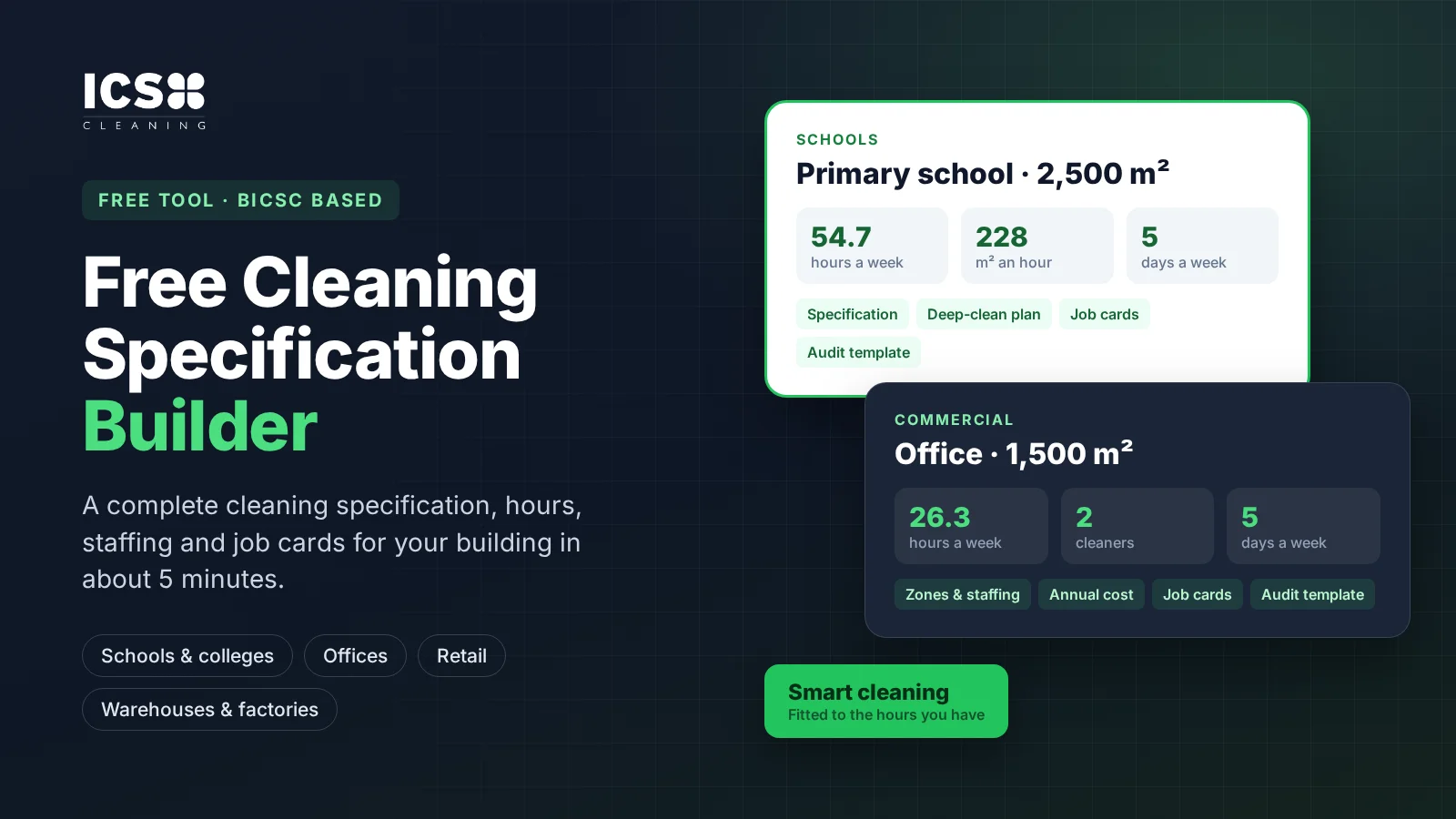
- 2As a guide, a 1,500 m² office needs about 26 cleaning hours a week and a 2,500 m² primary school about 55, using BICSc productivity rates.
- 3When hours are below the standard, smart cleaning keeps hygiene-critical tasks fixed, moves lower-risk work to a rotation and scores the audit to match.
In short: a cleaning specification builder turns the facts about a building (its type, floor area and rooms) into a complete cleaning specification, with tasks, frequencies, standards, cleaning hours, a staffing plan and job cards. ICS Cleaning offers two free builders: the School Cleaning Specification Builder for nurseries, schools, academies and colleges, and the Commercial Cleaning Specification Builder for offices, shops, warehouses, factories and food sites. Both use British Institute of Cleaning Science (BICSc) productivity rates and frequency charts, produce a first plan in about five minutes, and include an Excel audit template you can upload to an inspection app.
What is a cleaning specification?
A cleaning specification sets out which areas of a building are cleaned, the tasks in each area, how often each task is done and the standard expected. It is the document a cleaning service is planned, priced, delivered and checked against. A cleaning schedule is related but different: the specification is the what and how often, and the schedule is the when.
Most specifications are written from a generic template or an old contract, which is why they often miss areas, use vague standards or no longer match the hours available.
What is a cleaning specification builder?
A cleaning specification builder is a tool that writes the specification for you from your building's details. Instead of starting with a blank template, you start with a specification that already reflects your building's rooms and size, then adjust it.
The ICS builders work in three steps:
- Your building. Choose the type of building and enter the floor area. Schools can find their details from the postcode using the Department for Education register and their buildings' Display Energy Certificates. Commercial buildings can look up their floor area from the non-domestic Energy Performance Certificate register. No addresses are shown.
- Your rooms. Use a typical room layout for your type and size of building, paste a room list or upload a room schedule.
- Your specification and plan. The builder applies the right tasks, frequencies and standards to every area, works out the cleaning hours, suggests a team and produces the documents.
Your work saves as you go, and you can return to it from a private link.
Cleaning specification template or specification builder?
| Generic template | ICS specification builder | |
|---|---|---|
| Starting point | Blank headings or another site's wording | Your building's type, floor area and rooms |
| Frequencies | Copied or guessed | BICSc frequency charts for your type of building |
| Cleaning hours | Not included | Worked out from BICSc productivity rates |
| Staffing and zones | Not included | Suggested team, cleaning zones and job cards |
| Fewer hours than the standard | Not covered | Fitted to your hours with smart cleaning |
| Quality audit | Separate document, if any | Excel audit template built from the specification |
| Cost | Free | Free |
What does each builder produce?
School Cleaning Specification Builder
For pre-school and nursery, primary, secondary and special schools, and colleges and universities. It produces a complete School Cleaning Plan:
- Cleaning specification: scope, area schedule, frequencies, standards of cleanliness, colour coding and performance measures
- Frequency schedule: every task and how often it is done in each area type, in one table that suits tender returns
- Holiday deep-clean programme: periodic tasks such as floor care, carpet extraction, high-level dusting and washroom descaling, planned into the school holidays with estimated hours
- Staffing structure and zone plan: cleaning zones of a practical shift length, with a suggested team of zone cleaners, chargehands, a supervisor and absence cover
- Job cards: one per zone, with rooms in order, tasks by day, colour coding and a sign-off sheet
- Quality audit form and Excel audit template
Multi-academy trusts can build one specification per school, so every site is described in the same way.
Commercial Cleaning Specification Builder
For offices, non-food and food retail, and non-food and food industrial buildings. It produces a Commercial Cleaning Plan:
- Cleaning zones, staffing and shift times, including daytime cover and supervision where needed
- Indicative annual cost, worked out from the hourly pay rate you choose
- Frequency and day-by-day work schedules
- Room schedule, quality standards and KPIs
- A job card for every cleaner
- An Excel audit template
Commercial buildings are cleaned all year round, so there is no holiday deep-clean programme. Floor care, high-level dusting and glass are built into the year-round specification at the right frequency instead.
How are cleaning hours calculated?
Cleaning hours are calculated by dividing the floor area of each type of area by a recommended productivity rate (square metres cleaned per hour), then adjusting for how often each task is done. Classrooms, toilets, corridors, offices, sales floors and warehouses all clean at different rates, so a building's mix of rooms matters as much as its total size.
The ICS builders use BICSc productivity rates and frequency charts for each type of building, combined with ICS Cleaning's experience of running cleaning contracts. Commercial hours also allow for the number of cleaning days and how busy the building is. The Commercial builder uses the same calculation as the Office Cleaning Service Review, so the two tools always agree.
How many cleaning hours does a building need? Worked examples
These figures come straight from the builders, using a typical room layout and standard assumptions (normal footfall, average occupancy, no daytime cleaner). Your own building will differ, which is why the builders let you add your real rooms.
| Building | Floor area | Cleaned | Cleaning hours a week | Average rate |
|---|---|---|---|---|
| Nursery or pre-school | 600 m² | 5 days | 18.1 | 166 m²/hr |
| Primary school | 2,500 m² | 5 days | 54.7 | 228 m²/hr |
| Secondary school | 10,000 m² | 5 days | 206.2 | 242 m²/hr |
| Office | 1,500 m² | 5 days | 26.3 | 285 m²/hr |
| Supermarket | 2,500 m² | 7 days | 54.8 | 319 m²/hr |
| Warehouse or factory | 6,000 m² | 5 days | 80.5 | 373 m²/hr |
For the 1,500 m² office, the builder suggests two cleaners (one working 3 hours a day and one 2.5 hours a day), with standards checked by an area manager. At £12.60 an hour, the indicative annual contract price is £33,000 to £41,500. These are planning figures, not quotations; a site survey confirms the final figure.
What if a building has fewer cleaning hours than the standard?
If a building has fewer hours than the BICSc standard suggests, the cleaning team is working at a higher productivity, and a specification that lists every task at the standard frequency no longer matches what can be delivered. The ICS builders handle this with smart cleaning: enter the hours you actually have and the builder fits the specification to them.
- Hygiene-critical tasks stay as they are. Toilets and washrooms, kitchens, dining and food areas, emptying bins, sanitary cleaning and consumables are never reduced. In schools, daily sweeping of teaching floors is protected too.
- Lower-risk tasks are done less often, in a set order. Detail work such as high-level dusting, furniture cleaning and machine floor care in lightly used areas moves to a rotation first, starting with the largest areas.
- Every change is listed, so you can agree it with your team or contractor.
- If the hours can't be reached safely, the builder shows how far short you are rather than cutting hygiene tasks.
For example, a 10,000 m² secondary school with a BICSc standard of 206.2 hours a week can be fitted to 168.3 hours a week, about 82% of the standard, with every hygiene-critical task kept daily. If you have more hours than the standard, the builder can add frequency back where it will be noticed most.
This is the practical side of the approach in our article Smart Cleaning: Is Your Cleaning Specification Still Fit for Purpose?
How do you audit cleaning against the specification?
You audit cleaning by checking each area against the standard the specification sets, using a consistent scoring method. Both builders produce an Excel audit template from your specification: one question per row, set out by area, with what Good looks like for each check, so it converts cleanly in inspection apps that create templates from Excel.
The standards follow the BICSc three levels: acceptable on completion, acceptable between cleans, and unacceptable. When a specification uses smart cleaning, the scoring changes to match:
- Items cleaned every day are scored on completion.
- Items cleaned less often are scored against the between-cleans standard, unless the audit falls on their cleaning day, so nothing is marked Poor on a day it wasn't due.
- Critical hygiene items count double, and a Poor on any of them needs action the same day.
If you only need an audit, our free Cleaning Audit Templates offer a ready-made template for each of ten types of school and commercial building.
How to build a cleaning specification in five steps
- Open the School or Commercial Cleaning Specification Builder.
- Choose your type of building and enter the floor area, or look it up from the postcode.
- Set the cleaning days and, for commercial buildings, shift times, daytime cover and supervision.
- Use a typical room layout, or add your own rooms by pasting a list or uploading a room schedule.
- Review the hours, team and specification, fit them to your hours if needed, then download your plan and audit template.
Who should use a cleaning specification builder?
- School business managers, bursars and trust estates teams writing or reviewing a specification, or preparing a tender
- Facilities, office and property managers planning or re-tendering commercial cleaning
- Procurement teams who need every bidder to price the same, clearly defined requirement
- Anyone checking an existing service who wants to know whether the hours and frequencies are realistic
If you already have a specification and want to check it rather than rebuild it, the Specification Health Check shows what is missing or too vague to enforce. For a quick question about your own building, IntelliClean™ can work out indicative hours in the chat and point you to the right tool.
About ICS Cleaning
ICS Cleaning Services is a commercial cleaning contractor based in Hull and part of the SPS Group, providing school, office, retail and industrial cleaning across Yorkshire and Lincolnshire. The company is certified to ISO 9001 and ISO 14001. The specification builders are based on the same methods ICS uses to plan its own contracts.
Build Your School Cleaning Specification
Free to use. About 5 minutes for a first plan.
Cleaning an Office, Shop or Warehouse?
Hours, team, annual cost, schedules and job cards for commercial buildings.
Build Your Cleaning Specification
Free to use. Choose the builder for your type of building.
Open the School Specification Builder